

Montreux Collaborative Blog
It’s 2026 - why can’t we accurately track health resources?
Tyler Smith, Cooper/Smith
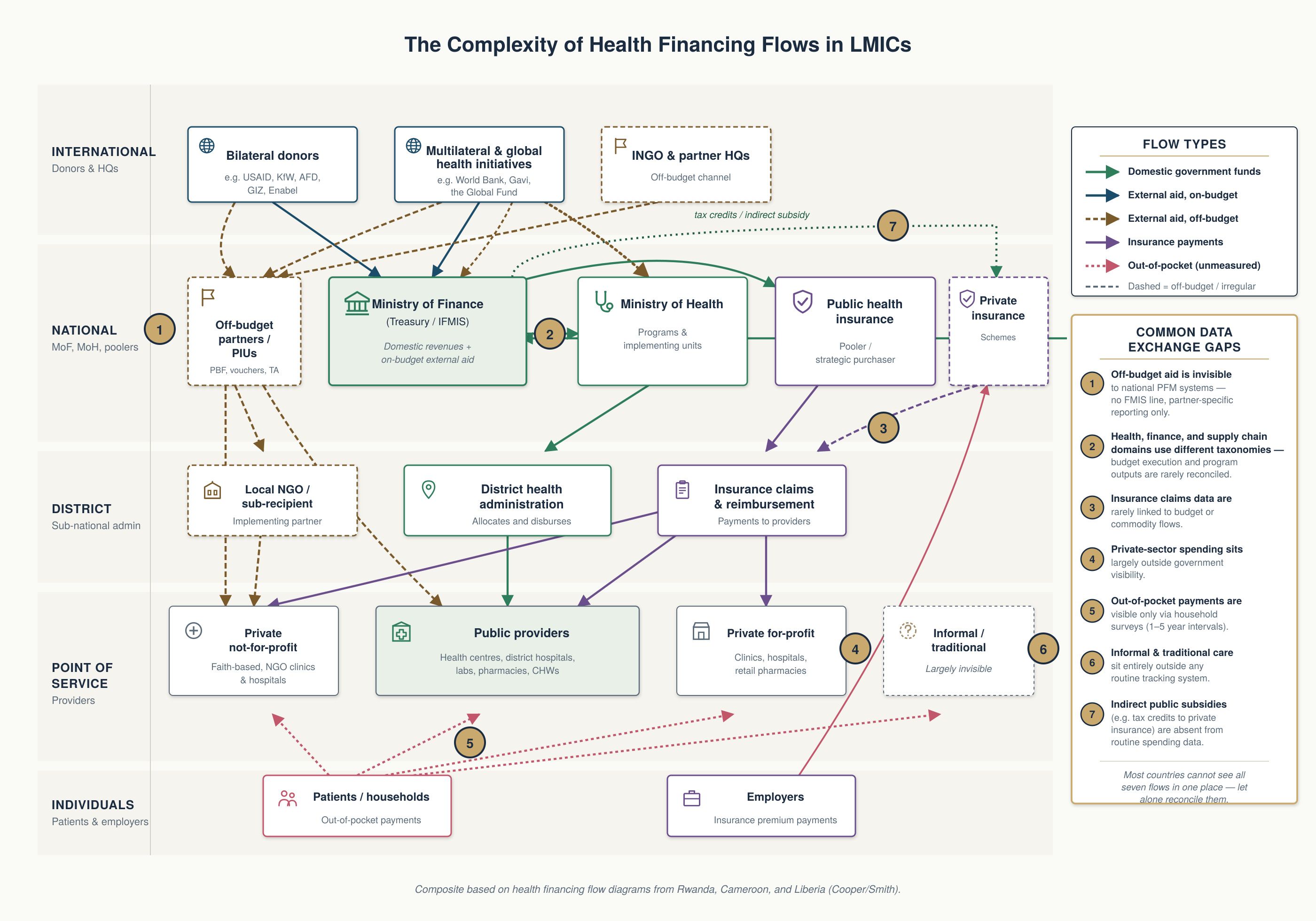
Country governments have had limited visibility into health resource flows for too long. These data are needed now more than ever, and technology can help. In this blog I review the evolving context and suggest some practical ways forward.
The new order of global health finance
We are witnessing a seismic shift in the way health is funded, governed, and administered globally.
Tariff hikes, forex shortages, and rising debt service are happening at the same time as deep, synchronized cuts to development assistance for health (DAH). This combination will, no doubt, strain fragile health systems and have ripple effects for years to come.
Some leaders are treating this not as a crisis, but as an opportunity. From the Lusaka Agenda (2023) to the Accra RESET (2025), the shift away from aid dependency and toward national health sovereignty is underway. Both agendas call for stronger health systems, increased domestic financing, better alignment of spending with disease burden, and enhanced coordination and accountability – all necessary and overdue. But the harsh economic reality is that, in the near term, less money is available to meet expanding needs. Navigating this new order will require hard, technically complex trade-offs and a persistent blind spot leaves countries ill-equipped.
The blind spot: accurate and timely financial data
Most countries cannot say with precision how much money is available for health in a given year, what was actually spent, or what services that money purchased.
Funding flows are elusive in mixed systems where public hospitals, private clinics, faith-based providers, and NGOs coexist, and where governments, insurers, donors, and households all jointly finance care. Unrecorded out-of-pocket payments represent a large share of health expenditures, but are usually measured only in population surveys (too infrequent for routine estimation and adaptive policy).
External support adds another layer of opacity. It is often “off-budget,” bypassing national public financial management (PFM) systems and being recorded (if at all) in donor-specific systems.
Gaps in tracking is also concerning because so many financing models rely on the opposite assumption. The Global Fund's co-financing policies depend on accurate estimates of domestic health expenditure, with the current cycle expecting to mobilize US$69.7 billion in domestic resources between 2027 and 2029 (roughly half of projected need across HIV, TB and malaria). The National Health Compacts facilitated by World Bank and WHO plot ambitious domestic reform goals for UHC in 15 countries, with several committing to significant increases in public health spending and insurance coverage. New "America First Global Health Strategy" agreements between the US Government and partner countries likewise tie performance to "self-reliance."
These partnership mechanisms all suppose we can reliably measure domestic and external contributions. We cannot; unless we fundamentally upgrade health resource tracking. Put simply, financial data remain the least evolved part of health systems monitoring.
What we have now, and why it falls short
Over the past decade, LMICs have made significant progress on digitizing routine health information systems (e.g., health and district management information systems (HMIS/DHIS2), building disease surveillance platforms, and experimenting with AI for analytics. But the systems that track the money — financial management information systems (FMIS) and partner reports— remain siloed and are rarely integrated with service delivery or output data.
National Health Accounts (NHAs), built on the System of Health Accounts (SHA) methodology, remain the most established global framework for tracking health spending. More than 130 countries produce them periodically with WHO support, and the results populate the WHO Global Health Expenditure Database. But NHAs are typically produced every one to three years, retrospective by several years, and require substantial consultant-driven effort to compile. No doubt these efforts, can and do add value. But we need smarter tools to obtain usable data more quickly, while they are still relevant for proactive decision making.
To compensate for weak integration of financial data in health information systems, various Resource Mapping and Expenditure Tracking (RMET) frameworks emerged. These exercises attempted to consolidate spending across domestic and external sources to inform planning. In practice, they have been episodic and donor-driven, implemented through unwieldy spreadsheets and manual consolidation, run in parallel using overlapping source data but different classifications, and burdensome for respondents — with low compliance and heavy reliance on consultants to "chase the data."
We clearly need a new approach to data production if we are to move from “bean counting” to actionable intelligence, and the barriers are not technical. There is a robust ecosystem of open-source tools and standards that enable data integration: OpenHIE and related frameworks for health information exchange; FHIR and other international standards to automate data transfer; and the WHO SMART Guidelines for developing health systems in the digital age. Despite adoption of these frameworks in many LMICs, finance and procurement systems largely remain out of scope.
Shifting investments to enable next-generation resource tracking platforms
If the Lusaka Agenda and Accra RESET are to be more than aspirational, Health Resource Tracking (HRT) needs to evolve from an episodic, donor-driven exercise into a systematic component of national planning and budgeting. Recognizing this need, in May 2025 the World Health Assembly adopted Resolution WHA78.12 on strengthening health financing globally, urging Member States to build "institutional capacities, as well as national data collection and reporting systems, for routine monitoring and reporting of domestic and external health resource tracking" — integrated with national PFM systems and leveraging digital technologies.
Achieving this vision requires a new lens on HRT that synthesizes best practices from PFM, economic evaluation, software engineering, and digital transformation. At minimum, a next-generation HRT system should focus on 6 imperatives:
- Adopting a narrowly defined use case approach to systems development is a proven way to deliver value. Explicitly specifying actors, goals, interface points, and outcomes forces realistic design choices, builds stakeholder alignment, and makes trade offs transparent. Prioritized, documented use cases provide a clear basis for strategic alignment.
- Enabling any use case requires routine data exchange across multiple systems. This exchange must be structurally incentivized, not aspirational, through enforceable instruments such as service level agreements, memoranda of understanding, and data sharing agreements.
- Because health resources often flow outside central systems, capturing off budget data has historically been manual and burdensome. There is a clear gap for simple, user friendly reporting interfaces that allow financial data submission in standard formats. These tools should resemble customer relationship management software (CRM) software, limit reporting to fields relevant to each provider, automatically apply resource allocation standards, and integrate with widely used commercial accounting platforms.
- A major constraint on data quality and timeliness is the effort required for data validation and cleaning. With adequate interoperability, current technologies can automate much of this work, representing the largest opportunity for efficiency gains in HRT data production.
- Sustained use of HRT data also depends on low friction access. Users should have multi modal options—including web portals, dashboards, messaging services, and natural language chatbots—to retrieve pre specified standard reports, with analytics pre pipelined to meet stakeholder requirements.
- Finally, modern HRT systems must support lightweight, intuitive tools for ad hoc analysis. While standardized views are essential, actionable intelligence requires the ability to easily slice, filter, and customize analyses to answer urgent or context specific questions.
None of these concepts are new. The challenge is that most investments to date, whether domestic or donor-supported, have not been structured to deliver on these imperatives. They prioritize rapid, manual data gathering, often in reaction to immediate information gaps or funding requirements, and leave available technology substantially underutilized.
May 11, 2026